Category

Blog
Positioning Life Insurance in a Holistic Financial Plan

Positioning Life Insurance in a Holistic Financial Plan

Talking About Life Insurance

We like to pretend we are going to live forever. Most of us would rather do just about anything other than think deeply about our own death. That’s why effectively positioning life insurance to clients is particularly challenging.

Nobody wants to ponder their own mortality. But the reality is that we will all die at some point, and most of us want our loved ones to be well taken care of when that time comes. That’s why selling life insurance is such an essential part of holistic financial planning. You have to learn how to talk to clients.

Selling life insurance is a very personal venture—you are discussing delicate and painful topics.Visit Clarity Insurance Marketing

When positioning life insurance to your clients, focus on the beneficiaries. People primarily buy life insurance to cover end-of-life expenses and care for their surviving family members.

Why a Plan is Not Holistic Without Life Insurance

The Bucket Plan Process is foundational to holistic financial planning and everything we do at C2P Enterprises—including life insurance.

Most Insurance Marketing Organizations (IMO) focus on gross production and sales from their agents and advisors. But we concentrate on client solutions that are in their best interest. We mitigate risk for clients by helping advisors incorporate our best-interest approach in case design, product selection, and implementation of insurance solutions as financial planning tools.

Clarity Insurance Marketing is a best interest-focused insurance marketing organization that specializes in screening, selecting, and supporting top-quality fixed insurance products. Their award-winning services cover fixed and indexed annuities, single premium and traditional life insurance, and asset-based long-term care products.

Clarity Insurance Marketing works with holistic advisors committed to representing the client’s best interests. As such, almost all affiliated advisory practices have either a Registered Investment Advisor (RIA), Investment Adviser Representative (IAR), or registered representative of a broker-dealer in their office to help represent life insurance as a part of a holistic financial planning solution. We mitigate risk for institutions, advisors, and American families nationwide.

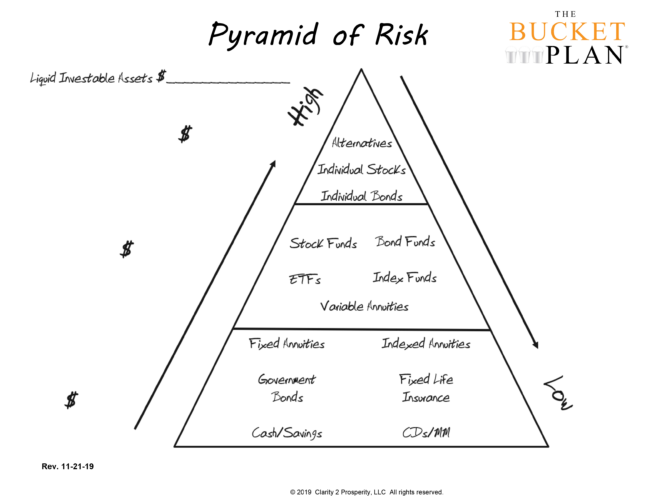
To better understand their needs, take each client through the Pyramid of Risk, discern their volatility tolerance, and measure their tax bracket.

Pyramid of Risk, from The Bucket Plan

It’s crucial that you stay up-to-date on the fast-paced and ever-changing life insurance industry. Study your clients. Try to understand their challenges and goals, so you can find a product that fits their needs.

Once you know what the client expects from a life insurance policy, you can introduce products to help them achieve their goals.

Bucket Plan Certification

Structuring the Conversation of Life Insurance with Your Customer

Positioning life insurance to a 20-year-old is very different than selling life insurance to a 60-year-old. But no matter who you are working with, you should be able to ask questions like,

If you died tomorrow, would your family be able to pay their bills and continue their current lifestyle?

Financial advisor client communications should begin by educating them on the difference between term and permanent life insurance, including the advantages and disadvantages of each.

Term life insurance is one of the most popular types because of its simplicity and low premiums. These policies are great for healthy young clients who can secure reasonable rates and use the savings to invest in other securities, but they only pay out if the policyholder dies during the policy period.

For example, term life insurance is better for people ages 25-45. They are typically working through life events like buying a home, getting married, growing their families, or saving for college. They usually have a lower net worth than older age groups and higher debt-to-income ratios.

“Term is like renting an apartment. Permanent is like buying a house. When you rent an apartment, you are building no equity, but it’s generally cheaper. When you buy a home, you’re going to pay more, but you get equity in return. With term life insurance, you have a liability, but no asset to show for it.”  –Dave Alison, CFP®, EA, BPC

Learn more about The Bucket Plan Process and positioning life insurance to your holistic financial planning clients.

Schedule a Complimentary Call

Financial Professional Use Only

The information provided in this presentation is not intended as investment advice or legal advice. The information provided is for informational and training purposes only. The information in this presentation was accurate as of the time of the material was created. Tax laws and rulings can frequently change. Please discuss the client’s current situation with an accountant or tax advisor.

Tax Planning Considerations for 2022

Tax Planning Considerations for 2022

Tax Planning Considerations Financial Advisors Should Share with their Clients in 2023

A recent Grant Thornton survey of tax executives found that over 50% were either re-evaluating their tax planning considerations for 2022 with potential legislation in mind or actively implementing changes in response to legislative developments.

Tax planning considerations for 2022 include a variety of internal and external factors:Click Here to Take Your Clients on the Tax Management Journey

  • COVID-19 pandemic
  • Economic volatility
  • Global tax agreements
  • Inflation
  • Interest deductions
  • Legislation
  • Remote work
  • Research cost recovery
  • Revenue recognition
  • Supply chain issues

Use tax planning strategies to minimize the cumulative lifetime taxes for your clients and their beneficiaries so that avoidable taxes don’t diminish vital savings.

What are you doing to ensure your client’s family doesn’t end up with a bill to Uncle Sam upon their death?

Engage in tax-loss harvesting and use those losses to achieve gains through other investments that have significantly appreciated during the bull market that led up to 2022. This helps to rebalance the portfolio and control style drift and does not subject the client to taxes.

You can also swap funds of similar exposures to avoid IRS wash sale rules.

You should review the client’s holistic financial plan, so you can recommend tax planning strategies that will result in lower taxes long term.

How To Win Business Through Tax Planning Seminar

Consider Roth Conversions of Devalued Assets

Look at the individual retirement account (IRA) portfolio and select the assets that have seen the greatest devaluation. Then, convert those underperforming holdings to Roth IRAs.

If those assets recover from the current market downturn, the Roth IRA would recover tax-free!

Consider IRA withdrawals if the client has cash flow analysis concerns. Roth conversions could be beneficial if your client’s heirs are in the same or higher bracket.

Consider Exercising Stock Options

One of the most significant tax considerations for 2022 is timing. Knowing when to act and when to wait is essential.

For instance, you should consider exercising stock options when share prices are down to help reduce income taxes on non-qualified stock options (NSO), and alternative minimum taxes (AMT) on incentive stock options (ISO).

Work with Your High-Net-Worth Clients to Create Larger Deductions

Did you know that 92% of high-net-worth investors expect their advisor to provide tax advice, but only 25% of them are receiving it?

One of the most important tax considerations for 2022 and beyond is to be proactive to changes in the market, not reactive. This will help you forecast accurate predictions that will save your customers money.

By putting solutions and strategies in place to anticipate changes, you will differentiate yourself from other advisors and tax professionals, allowing you to charge more considerable financial planning fees.

For affluent clients in high tax brackets who have non-qualified money, you should consider direct indexing separately managed account (SMA) strategies with aggressive daily tax loss harvesting. This creates large deductions with the wild daily volatility of the stock market.

Have Your High-Net-Worth Clients Gain through their Generosity

For your wealthiest investors, consider giftings a portion of their assets to irrevocable trusts now, while the gift tax exemption is high and valuations are low.

The client will get more return on their investment from a taxable estate while consuming less of the gift tax exemption now that valuations are reduced.

Financial advisors must be aware of many tax planning considerations for 2022 as they work to win business through tax planning.

C2P Enterprises can help you provide better financial advice and tax planning considerations for next year.

Schedule a Free Consultation


Financial Professional Use Only

The information provided in this presentation is not intended as investment advice or legal advice. The information provided is for informational and training purposes only. The information in this presentation was accurate as of the time of the material was created. Tax laws and rulings can frequently change. Please discuss the client’s current situation with an accountant or tax advisor.

Communication Tools for Financial Advisors in a Digital Environment

Communication Tools for Financial Advisors in a Digital Environment

Effective client communication uses your own processes for success

In a 2019 survey, 85% of respondents said they would consider a financial advisor’s communication style when deciding whether to retain their services or not. This highlights just how vital it is to adopt the right financial advisor technology to enhance interactions and client satisfaction.

So, what digital tools for financial advisors can you use to strengthen client relationships and deliver ongoing value across every stage of the customer lifecycle?

Think of your client communication tools as a digital assistant

Today’s financial advisor tech landscape includes a wide variety of digital marketing tools:

  • Instant messaging apps
  • Project management software
  • Video conference systems
  • Document storage solutions
  • Calendar schedulers
  • Social media integrations
  • CRM

These digital tools for financial advisors allow you to streamline daily operations, maintain client engagement, and grow your business. Before implementing any new tools, be sure to get marketing compliance approval.

How can a CRM assign your tasks effectively?

A CRM (Customer Relationship Management system) is one of the most valuable pieces of financial advisor technology. It allows you to store client data, track interactions, notes from meetings, buyer’s journey and automate communications.

Marketing strategies for financial advisors include assigning and scheduling automated marketing campaigns and content like lead nurturing emails that a lead or client triggers in the CRM with their online behavior.

All of your content, including anything published on social media, should be approved by marketing compliance.

How can you build out your practice’s CRM10 Digital Marketing Tips to Drive Business in 2023

Unfortunately, most wealth managers aren’t marketers, so they’re probably not taking advantage of all the benefits and features of their CRM.

For advisors to succeed, they need to reach new prospects and leads to expand their client base, so optimizing the CRM is the first step to growing and scaling marketing strategies for financial advisors.

  • Schedule automated marketing workflows that will constantly be working behind the scenes to keep your prospects, leads, and clients engaged with your firm and the content you produce.
  • It has the capacity to track all activities, so utilize your CRM to maintain contracts, files, notes, call logs, etc.
  • Document the interactions between advisors and clients in your CRM ensures that anyone in your firm can pick up the phone and confidently call a client in your database because the advisor will have all of the relevant information right in front of them to reference.

Reporting is your secret weapon

The most effective financial advisor tech and the best marketing strategies for financial advisors include detailed tracking and reporting metrics.

Digital marketing for financial advisors has redefined how wealth managers talk to clients. We have the capabilities to follow a user’s behavior and see how they interact with our content and marketing efforts, then analyze that data to make smart business decisions.

Using a scheduling App to optimize your day

Scheduling meetings takes up valuable time throughout your day that could be better spent.

The best digital tools for financial advisors include built-in calendar sync and customizable reminders, helping you stay on top of every task.

Set daily, weekly, monthly, and quarterly reminders for yourself, so nothing falls through the cracks again.

How can advisors ensure their communication tools work together

For financial advisors looking to implement automated marketing communication tools, the goal should be an optimized client experience.  Make sure any systems or processes you implement come with a smooth transition and easy-to-use features your clients won’t struggle to access.

Integration is key. If you have a dozen different tools that don’t work together toward a common goal, your practice will suffer from the confusion that occurs.

Essential Guides for Financial Advisors

Build a modern client experience with the right financial advisor technology

C2P Enterprises provides marketing services to firms in the financial industry.  Our digital marketing programs help advisors:

  • Build brand awareness
  • Increase credibility
  • Automate their marketing processes giving them the freedom to become a better financial advisor.

For more information on our marketing programs

Schedule a 20 Min. Call

Financial Professional Use Only

The information provided in this presentation is not intended as investment advice or legal advice. The information provided is for informational and training purposes only. The information in this presentation was accurate as of the time of the material was created. Tax laws and rulings can frequently change. Please discuss the client’s current situation with an accountant or tax advisor.

Social media for financial advisors

6 Social Media Networks Financial Advisors Should Use in 2022

Why Social Media Marketing Works for Financial Advisors

According to LinkedIn, 92% of financial planners who use social media for business purposes report that it has helped them get new clients.

Wealth managers should consider developing social media and marketing strategies for financial advisors to:

  • Increase brand awareness
  • Digitally connect with leads and clients
  • Generate referrals
  • Stay top-of-mind in a competitive landscape

Share Your Expertise and Strengthen Client Trust

Encourage your team to actively share updates on:

More people go to social media to get news and information like this than ever before. And they expect you and your business to satiate their hunger for knowledge and financial literacy.

As more people turn to platforms like LinkedIn, Facebook, and YouTube for financial education, your firm has a major opportunity to provide credible, compliant content—and build trust while doing so.

Grow Through Marketing

Each Social Network Requires a Different Approach

Before developing marketing strategies for financial advisors, the first thing to consider is SEC marketing compliance. Like all other forms of financial advisor client communications, social media for financial advisors must follow marketing compliance.

Those penalties start to add up quickly if you don’t carefully adhere to the Securities and Exchange Commission’s rules and regulations. According to FINRA, the fine for misinformation in the financial services industry can be as much as $3.8M.

Strategies involving social media for financial advisors should not replace your existing marketing plan. Instead, look at if and how each individual platform will fit into the marketing strategies for financial advisors that you currently practice.

Digital marketing for financial advisors complements other advertising methods to enhance the overall client experience.

1. LinkedIn: Your B2B Powerhouse10 Digital Marketing Tips to Drive Business in 2023

Social media for financial advisors can be tricky to navigate. Sometimes users experience negative feelings if you’re trying to sell them something when they’re trying to scroll through cat photos. On LinkedIn, however, you don’t have to worry about that as much.

LinkedIn is an online professional networking platform that provides business-oriented services like job boards and resume builders to individuals and companies alike. Because it focuses more on the professional than the personal, there is more freedom to follow a hard sell approach on this platform than on others.

All digital marketing for financial advisors, including anything published on social media, should be approved by marketing compliance.

2. Facebook: Broad Reach, Deep Engagement

Facebook is arguably the most well-known social media platform of all time, so all marketing strategies for financial advisors should incorporate it both organically and from a paid advertising perspective.

3. Twitter (now X): Stay Relevant and Real-Time

Twitter is a text-based microblog; each tweet can only contain a maximum of 280 characters. This includes the text for your post and any emojis, hashtags, or links, so brevity is key.

Hashtags were born on Twitter. They’re essential to getting in on the conversation and reaching the right audiences. You should follow governmental organizations like the IRS and SEC and filter their content to be relevant to your audience and their needs.

Because it is so text-heavy, including images can really help your content stand out when users are mindlessly scrolling.

4. YouTube: Educate with Evergreen Video Content

Did you know YouTube is the world’s second-largest search engine after Google? Imagine all the online traffic you’re missing out on if your firm doesn’t have a YouTube channel.

According to Hubspot, the amount of online video consumers watch has almost doubled since 2018, and 94% of marketers say video has helped increase user understanding of their product or service.

When you’re in as complicated an industry as ours, simplifying processes for your clients is priceless.

5. Instagram: Make Finance Visual

Instagram is an image-based app owned by Facebook’s parent company, Meta. The term social media influencer was coined on Instagram.

How can you position yourself as an influencer on social media for financial advisors?

6. TikTok: Engage the Next Generation

TikTok is a short-form video app. It has the youngest audience out of the platforms we’ve covered above.

This means there is a wealth of opportunities to get in before the space becomes cluttered.

Final Thought: Social Media is a Trust-Building Tool

Social media for financial advisors sometimes means weeding through bad actors who offer advice but have no credentials or valid data to back up their claims.

Again, please ensure all digital marketing for financial advisors has been approved by marketing compliance before it goes live.

Learn more marketing strategies for financial advisors and how to incorporate digital media into your traditional marketing mix

Download The Marketing 101 Guide

Financial Professional Use Only

The information provided in this presentation is not intended as investment advice or legal advice. The information provided is for informational and training purposes only. The information in this presentation was accurate as of the time of the material was created. Tax laws and rulings can frequently change. Please discuss the client’s current situation with an accountant or tax advisor.

Best Referral Sources for Financial Advisors

4 Best Referral Sources for Financial Advisors

What are the best referral sources for financial advisors?

One of the best referral sources for financial advisors is mutually beneficial relationships.

Relationships like referral programs, which are one of the best forms of marketing for financial advisors because they generate new leads and increase revenue.

The key is knowing who to ask and how to ask for the referral.

  1. Current Clients
  2. Lawyers & CPAs
  3. HR Consultants
  4. Recruiters

Can financial advisors pay for referral sources?

An SEC-registered investment adviser firm may pay cash referral fees to a third-party (non-employee) if the solicitor complies with SEC Rule 206(4)-3 under the Investment Advisers Act of 1940 while soliciting investment adviser clients.

So, the short answer is, yes.

But why would you want to when there are so many free referral sources in your personal circle and your wider community?

  • Clients
  • CPAs
  • Doctors
  • Family
  • Friends
  • Head Hunters
  • Human Resources
  • Lawyers
  • Realtors

Earning Business Through these Referral Sources

How do financial advisors get referrals?

First and foremost, they ask for them.

If your clients trust you and believe you are building long-term wealth for their families, then they will be happy to share your knowledge and expertise with their friends and colleagues.

It never hurts to ask.

What sources can you draw on within your network to feed your sales funnel besides existing customers?

Think of all the areas of holistic financial planning—taxes, insurance, health care planning, estate planning, etc.

How can you partner with professionals and businesses to share referrals and recommendations?

Marketing for financial advisors includes networking and building mutually beneficial relationships with others both within the industry and on the fringes of the financial sector.

  • People are 400% more likely to become clients after their friend refers an advisor.
  • Referred customers have a 16% higher lifetime value than those who weren’t.
  • A referral introduced 58% of wealthy investors to their wealth planner.
  • Fewer than 11% of financial planners actively request referrals.
    Source: 7 Client Referral Ideas to Help You Get More Referrals

1. Your Own Customers

The best referral sources for financial advisors are their own happy customers.

Asking for referrals helps clients feel closer to you as their financial planner and your business as a whole. They might feel connected to helping your firm succeed in addition to feeling a sense of ownership of the friends and family members to whom they recommended your services.

If you recommend a less experienced advisor, take on your client’s descendants, who are earlier in their life and career path, they will put trust in that because you have shown your value.

Earn business for your junior/second chair advisor with the client’s family so that the clients will remain in-house for generations to come as the advisor progress through the career path.

2. Working with Attorneys and Accountants

Is there an attorney or accountant you have previously worked with who would agree to trade contacts and lend their credibility to vouch for you to their customers?

By partnering with a well-known and trusted professional in your area, you can offer holistic financial planning services to their clients at a special rate.

3. Human Resources Consultants

People need the most assistance during major life changes and situations that have financial implications. This includes everything from a job change, marriage, divorce, inheritance, births, deaths, etc.

HR representatives are one of the first lines of defense during these times.

If you can develop a rapport with them to refer people who are experiencing a crisis or transitionary period, you can find and help new clients during a particularly vulnerable time in their life.

The best marketing for financial advisors is helping ease the burden during times of great stress and uncertainty.

HR consultants are also one of the first people to know when someone transitions into a new high-paying role, so it would be wise to build and nurture relationships with them.

4. Executive Recruiters

Another group first to know about new well-playing jobs is executive recruiters.

Don’t neglect a prospect just because they may be early in their career, it’s never too soon to start planning for early retirement.

  • Give them center stage during your first interaction.
  • Ask about the types of clients and industries they work with.

Once you understand that, let them know that you will keep an eye out for opportunities to send your clients to them. Present yourself as someone who adds value before you start making requests.

You could say something similar to:

“We seem to work with a similar high-net-worth clientele. Whenever any of my customers inevitably need a recruiter, I’ll make sure to send them your way.”

After you have sent them some business, you can start discussing reciprocity and arrangements.

  • You can get referrals easily by earning them and then simply asking.
  • Delight your existing customers, utilize the Family Estate Organizer to facilitate the transition between generations, and partner with other professionals in your area.

Learn how C2P can become your all-in referral source for new customers in your area

Free 20 Minute Call


Financial Professional Use Only

  • The information provided in this presentation is not intended as investment advice or legal advice.
  • The information provided is for informational and training purposes only.
  • The information in this presentation was accurate as of the time of the material was created.

Tax laws and rulings can frequently change. Please discuss the client’s current situation with an accountant or tax advisor.

Early Retirement Tax Planning

Maximizing Your Client’s Tax Plan After Early Retirement

Early retirement tax planning requires significant preplanning, like contributing to tax-advantaged investments that don’t have early withdrawal fees. Tax planning for early retirement means the client will need to save more money earlier in their career path because they’ll need the funds earlier than ordinary retirees, and they’ll need it to last longer than most.

Does Your Client’s Financial Plan Have Room for Early Retirement?

Most people would love to retire early, but few have the means, financial advice, and tax planning strategies necessary to achieve early retirement. In order to actively save for early retirement, the client needs to diversify how and when their savings will be taxed. Doing so can successfully navigate the two major unknowns:

  1. How much of the client’s income will be taxable?
  2. What will the client’s tax rate be after they retire?

Holistic financial planning includes planning for early retirement if that’s the client’s goal. A lot of people incorrectly assume that when they retire, their money and taxes go into autopilot, but this will get them into trouble with Uncle Sam in the long run. A good financial advisor will be able to identify specific steps the client must take in order to minimize their tax burden and maximize their wealth in retirement.

Does Their Portfolio Permit for Early Retirement?

The client should fund their Roth IRA to the maximum for early retirement. Although they will be taxed on any gains withdrawn before turning 59 1/2, they can withdraw their contributions at any time without incurring penalties.

Clients should focus on early retirement tax planning if they:Click here to take your clients on the Tax Management Journey

  • Anticipate higher taxes in the future
  • Have excess room in their tax brackets
  • Could benefit from creating greater deductions now
  • Coordinate between their financial plan and tax plan
  • Want to eliminate avoidable taxes and penalties
  • Need tax distributions from retirement plans

Smart Planning is the Key to Success Early Retirement Tax Planning.

One way to maximize income in retirement is to invest in early retirement tax planning by taking advantage of accounts and investments that don’t have fees for withdrawing early or a tax on distributions from retirement plans.

For early retirement tax planning, you should consider an appropriate blend of tax-deferred and Roth accounts, depending on the client’s current tax bracket.

Looking for more resources and tax efficient strategies for your financial clients? Sign up for our on demand seminar: How to Win Business through Tax Planning.

For higher tax brackets, there’s a good chance that the client’s tax rate will be the same as it is today or lower during retirement. So it might be a good idea to maximize tax-deferred accounts. Think about dividing retirement savings between tax-deferred and Roth accounts for clients in a middle tax bracket and consider maxing out Roth accounts on clients in lower tax brackets.

Every Situation has its Own Set of Tax Traps

One of the most important parts of early retirement tax planning is having a game plan in place to address any tax traps that pop up as well as any tax advantages you can leverage to the client’s benefit.

  • Charitable Gifts
  • Healthcare Premiums & Deductions
  • Mortgage Changes
  • Property Taxes
  • Social Security Tax Torpedo

Early retirement tax planning follows the same principles as a traditional retirement plan—minimizing taxes and maximizing funds. Because early retirees will have fewer working years to accumulate wealth and a longer anticipated retirement than most, their plan requires an accelerated pace and scale.

To learn more about minimizing the tax on distributions from retirement plans, how to win business through tax planning, or the Tax Management Journey®, schedule a FREE 20-minute call today!

Financial Professional Use Only

The information provided in this presentation is not intended as investment advice or legal advice. The information provided is for informational and training purposes only. The information in this presentation was accurate as of the time of the material was created. Tax laws and rulings can frequently change. Please discuss the client’s current situation with an accountant or tax advisor.

Renting v. Building a Tax Practice

Renting vs. Building a Tax Practice

The most successful financial planners are always thinking about growth. They focus on how to attract prospects while expanding their services for existing clients through profitable business lines. Without adding a lot of personal time and effort, you can accomplish both simultaneously by building a tax practice within your financial advisory firm.

You don’t need to have a tax background to be successful. When you build out your own tax practice, you can start by hiring an accountant or CPA for your in-house team.

How to Build a Tax Practice as a Financial Advisory Firm

The goal of building a tax practice is to convert those clients to financial services clients eventually. Tax preparation allows you to get in front of customers once a year. This will enable you to review their taxes with them and provide an overview of how to include their tax planning strategy as part of a holistic financial plan.

The tax client might not be ready for your other services at first, but you’ll be there when they are.

Get Started with Your Tax Practice

There are several steps involved in starting a tax practice.

  • First, you need to build the foundation before starting a tax practice. This includes everything from office space and software to pens and business cards.
  • Next, you should hire a tax professional to prepare returns and market the business to bring in new clients.

Finally, make sure you hire someone to assist with appointment setting and other practice management tasks.

  • In Stage 1, things will be modest. For the first year or two, you and two accountants will handle all the business at hand – between 100-400 returns.
  • During Stage 2, you should be processing 400-1000 returns, so you’ll need to hire an additional advisor and possibly a tax practice manager.
  • By the time you reach Stage 3, your office will have 1000-2000 tax clients, with the potential addition of another advisor and additional accountants.

Plan your growth — get started now!

Renting a Tax Practice vs.  Owning a Tax Practice

If you’re unsure whether building or buying a tax practice is the right move for your financial advisory firm, consider the following:

  1. One way to find out if building a tax practice or buying a tax practice will work for your financial advisory firm is to partner with an existing tax firm. You do this by offering tax management services and holistic financial planning to their clients in exchange for their accounting services. You or one of your financial advisors will then meet with the clients to go over the return and lay out tax planning strategies for the coming year.
  2. Develop a relationship with a CPA or tax firm in your community to borrow their clients. After you have nurtured and developed your bond with them and their customers, you can start to look for longer-term solutions, like purchasing a tax firm or building your own tax practice. Set up a cost-sharing arrangement so that a percentage of any new business goes back to the host tax firm as part of the agreement. This gives you an excellent platform from which to attract new clients to your wealth management firm.
  3. Consider the Find, Mined, & Grind mindset:

Click here to take clients on the Tax Management Journey

  • Find brings the client in.
  • Mined formulates recommendations and closes the sale.
  • Grind manages the financial services portion moving forward.

As with building a tax practice and buying a tax practice, there are also advantages and disadvantages to renting one:

Advantages to partnering with a tax firm

  • You are approaching an audience that is already made up of tax clients.
  • Staffing is already managed, so you don’t have the expense of added accountants for tax season.
  • The tax firm can serve as your second office for meetings with potential financial services clients.
  • If the tax practice owner ever decides to sell or retire, you’re already ingrained as the next buyer.

Disadvantages to partnering with a tax firm

  • Limited penetration in the surrounding area since you don’t control the marketing.
  • You have little to no say in the staff hired.

Why Successful Financial Advisors Choose to Offer Tax Planning

A proven way to grow your existing financial services business is to add a tax practice. Preparing taxes and providing tax advice is one of the most significant opportunities that wealth professionals have today.

Delivering ongoing advice (taxes aren’t a one-time thing) and implementing effective, deeper tax management strategies helps you stand out as a unique, multi-solution financial advisor. It also showcases your firm’s capabilities to a new group of potential clients.

Now that you have tax clients, you can use their returns to find areas where you can save them money. This presents an opportunity to provide additional services, like strategic retirement and legacy planning, which you can explore further with The Bucket Plan®.

By putting solutions and strategies in place to anticipate tax changes, you will differentiate yourself from other financial advisors and tax professionals, allowing you to charge more considerable financial planning fees.

Check out the Tax Management Journey live training to learn more about incorporating tax strategy into your clients’ overall holistic financial plan.

Financial Professional Use Only

The information provided in this presentation is not intended as investment advice or legal advice. The information provided is for informational and training purposes only. The information in this presentation was accurate as of the time of the material was created. Tax laws and rulings can frequently change. Please discuss the client’s current situation with an accountant or tax advisor.

Building a Comprehensive Financial Plan

Building a Comprehensive Financial Plan

A comprehensive financial plan can ease the client’s mind and decrease anxiety around their finances in both the short and long term. Studies show that people feel more secure when they have a documented holistic financial plan like The Bucket Plan® to rely on.

The solution to any individual’s economic puzzle is holistic financial planning. The wealth professional can develop a one-of-a-kind proposal to maximize their customer’s wealth, health, and happiness while minimizing any potential tax pitfalls and managing gaps in the market.

What Makes a Comprehensive Financial Plan?

A comprehensive financial plan takes an in-depth examination of the client’s current financial situation. The wealth professional develops a strategy that will allow the client to live the life they want based on their individual goals and abilities. It plans for and accommodates events that occur in the client’s life.

Whether you follow cash-flow based financial planning or another method, your goal is to create a holistic financial plan that sets the client up for success now and in the future.

Cash-flow based financial planning takes a client’s current financial position and uses predictions and forecasting to determine their cash flow plans for the present and future. Cash-flow based financial planning gives you more freedom to explore holistic financial planning solutions you might otherwise not consider.

A Comprehensive Financial Plan Includes these Elements

The Bucket Plan Process is different from other financial advisor strategies because it’s based on internal and external factors—including changes in the market, job loss, birth of a child, death of a spouse, change in marital status, etc. It considers how a customer’s investment goals will continue to change and works to ensure the best outcome at each phase of the client’s life: Now, Soon, and Later.

The Now Bucket is for liquid cash. This is where sufficient funds are set aside for a year’s worth of income, an emergency fund, and sufficient money for expected expenses.

The Soon Bucket is the more conservative capital that’s designed for the first ten or so years of retirement, plus an inflation hedge. It needs to be much less volatile but invested to outpace inflation without subjecting it to the fluctuations in the stock market.

The Later Bucket is the client’s long-term growth designated funds.

What is included in this plan?

A Comprehensive Financial Plan is Easy to Adjust

For the client, a good comprehensive financial plan should be as easy as going in for an annual physical. The patient (client) meets with their doctor (financial advisor) for a checkup where they discuss any new issues that have come up recently.

A doctor might make adjustments to the patient’s prescription dosage, suggests new products, or run additional tests. Likewise, the financial advisor will alter the financial plan to meet the new needs of the client, suggest new products, or run market simulations to optimize success.

At C2P Enterprises, we follow The Bucket Plan methodology for our comprehensive financial plans.

The Bucket Plan® Best Interest Process is an asset allocation system wealth professionals use to develop cash-flow based financial plans that their clients will understand. It has been defined, refined, and tested by our model offices. It includes a set of easily replicated, proven processes for your business, no matter the size or scale.

After completing The Bucket Plan live training, you will transform your business with simplified financial planning and an increased closing ratio.

Schedule a 20 Minute Call

Financial Professional Use Only

The information provided in this presentation is not intended as investment advice or legal advice. The information provided is for informational and training purposes only. The information in this presentation was accurate as of the time of the material was created. Tax laws and rulings can frequently change. Please discuss the client’s current situation with an accountant or tax advisor.

4 Steps for Financial Advisors to Help their Clients Avoid Income Gaps

4 Steps for Financial Advisors to Help their Clients Avoid Income Gaps

Understanding the Gaps in Your Client’s Future Income

What if there was a quick and easy documented way of assessing whether your clients will have an income gap or excess cash flow when they retire? With the Income Gap Assessment, you will be able to discuss the overall cash-flow based financial plan with your clients and determine ways to guarantee their income in retirement.

We created the Income Gap Assessment to cut down on time spent with each client. This resource will allow you to skip the long budgeting process and get right to the important stuff.

The Bucket Plan® Best Interest Process is an asset allocation system used to develop simple, cash-flow based financial planning methods that your clients will understand. The holistic financial planning process is full of valuable resources.

The Income Gap Assessment is just one piece in a series of turnkey tools and processes available through C2P Advisor Guides.

There are four sections:

Income Gap Assessment

  1. Income Lost in Retirement
  2. Income Gained in Retirement
  3. Increased Expenses in Retirement
  4. Decreased Expenses in Retirement

How Financial Advisors Can Help Clients Avoid Income Gaps During Retirement

The first section is where you log the client’s net income after taxes.

This is the current amount being deposited into checking from salary, wages, and other sources of income pre-retirement. You want to determine the difference between their annual bring-home salary and their yearly living expenses.

After you calculate the annual net income, ask the client to choose which of the following scenarios most closely applies to them:

  1. Breaking even and consuming all your net income.
  2. Managing to save money by consuming less than your net income.
  3. Losing money and going into debt.

The second section focuses on income gained after retirement. Between Social Security and pensions, what will their fixed income be once they are no longer earning a paycheck?

For Social Security optimization, clients may delay one or both of their benefits. This will leave a larger gap income for a short period of time. In these cases, consider conducting multiple Income Gap Assessments for the different time periods to get an accurate picture of their cash-flow based financial planning strategy throughout retirement.

Another option is to do one Income Gap Assessment as if all fixed income sources are activated. Then, determine the amount of assets you would need to set aside to cover the bridge needed to make up for the delayed income.

Social Security Reform Planning in 2025

Planning for the Impact of Taxes on Your Client’s Financial Plan to Avoid Income Gaps

You should list anything that might affect retirement income under the increases in expenses section.

Ask your clients about potential increases from income tax increases, health insurance premiums, increased travel expenses, etc.

Tax planning is one of the most significant opportunities wealth professionals have. Clients often view tax planning as their most daunting and confusing retirement expense. You can use their tax returns to find areas where you can save them money and avoid income gaps in the future.

“A competent financial planner can evaluate multiple years of prior 1040s and supporting documents to inform present tax planning decision and identify planning opportunities and areas of concern for the current and future periods.”

– Certified Financial Planner Board of Standards

Understanding the Accounts that Can be Drawn Against for Emergencies

Next, you should log all major expenses that will decrease after they retire. Will they pay off a loan or mortgage? How much do they have in their savings account?

With these three figures, you can derive the gap income that will need to be taken from liquid investable assets in retirement.

The Income Gap Assessment exercise aims to determine the gap between the net income a client is currently living on while working and the fixed income sources they will have after retirement.

It is based on a consumption methodology of budgeting and will provide an accurate amount that they will need to draw off their liquid investible assets once they retire. This assessment is particularly useful and efficient for clients and prospects who will be retiring in fewer than ten years.

Planning for Future Unplanned Expenses

Net Income Need – Fixed income – Adjustments = Total Income Gap     

Once you have the final number, you’ll know if the client has an annual surplus or deficit for their retirement. If there is an income surplus, they will have excess cash flow. Knowing this will allow you to act more strategically with their holistic financial plan or cash flow analysis.

The Income Gap Assessment is a viable tool to determine what kind of situation your client may find themselves in once they retire. If you determine the client has a gap income, you should ask them the following question.

“How much of this income gap do you want guaranteed in your financial plan?”

This will serve as a basis for their total income needed in retirement. It also creates an opportunity for you to show them how you can guarantee their income once they retire.

The Income Gap Assessment is just one tool in a series of resources and assets found in The Bucket Plan® Best Interest Process.

The Bucket Plan Best Interest Process

The Bucket Plan® Best Interest Process is a proven, turnkey holistic wealth planning process for gathering data, documenting findings, and delivering asset-positioning strategies in your clients’ best interest. We have defined, refined, and tested it so businesses of any size can replicate it.

Schedule a Consultation

Financial Professional Use Only

The information provided in this presentation is not intended as investment advice or legal advice. The information provided is for informational and training purposes only. The information in this presentation was accurate as of the time of the material was created. Tax laws and rulings can frequently change. Please discuss the client’s current situation with an accountant or tax advisor.

C2P Enterprises animated family estate organizer

Optimizing Your Client’s Financial Plans with the Family Estate Organizer

The Family Estate Organizer (FEO) is a holistic financial planning tool that handles the process of settling an estate, as well as assisting the family and any professionals involved.

The FEOThe Family Estate Organizer® streamlines and organizes all essential personal information and fi­nancial documentation into a single comprehensive binder.

There is typically one individual that handles the coordination and organization of the family’s ­financial life.

  • If something happens to that family member, such as death or disability, the survivors are left unorganized and lost.

The Family Estate Organizer provides a centralized location for all crucial information and becomes a go-to resource for the client and their family. Including:

  • Legal documents
  • Insurance policies
  • Brokerage statements
  • And more

It creates peace of mind for the client and their loved ones.

Having a customized FEO built can save a family a lot of time, energy, and heartbreak after an already devastating loss.

An Estate Organizer can accompany the client to the funeral home or attorney’s office, etc.

Why Do Successful Advisors Use Estate Organizers?

We’ve all been there. Collecting and organizing an entire lifetime’s worth of documents is stressful and frustrating.

Introducing an Estate Organizer during your first meeting can help show your client the value of holistic financial planning tools and ensure everyone is on the same page.

The FEO covers everything, including:

Download our Advisor Guide to Simplify Financial Planning with The Bucket Plan Best Interest Process

  • Asset Sheet
  • Bank Accounts
  • Contact Information
  • Debt Statements
  • Final Arrangements
  • Income Tax Returns
  • Legal Documents
  • Life Insurance
  • Long-Term Care Assets
  • Medical History
  • Pensions
  • Personal Documents
  • Post-Tax Investments
  • Prescription Information
  • Pre-Tax Investments
  • Property Records
  • Social Security
  • Survivor’s Checklist
  • Tax-Favored Accounts

Getting the Right Information at the Right Time

The FEO combines all the clutter and paper that arises during the resolution of an estate into a single easy-to-follow binder.

When a new couple comes into the office, they’re often overwhelmed by all the paper they’ve accumulated and don’t know where to start.

It’s common that only one of them has been handling the family finances, and the other is clueless.

So, the first step is getting them organized and on the same page so that everyone is speaking the same language. Ensure all parties understand their net worth, cash flow analysis, and basic concepts like the money cycle.

Learn more about financial advisor client communications.

Utilizing the FEO in your first meeting with clients will put their minds at ease and educate them on The Bucket Plan® principles like the money cycle and planning for now, soon, and later.

Estate Planning Tools that Help in the Process

An Estate Organizer is much more than a simple financial or legal tool.

It stores all important client information that allows the survivors to better handle the estate upon a client’s passing, such as:

  • Investments
  • Pensions
  • Medical information
  • Life insurance
  • A family succession plan
  • Survivor’s Checklist

The Family Estate Organizer also helps wealth professionals to:

  • Build client relationships when building trust
  • Uncover hidden or forgotten client assets
  • Prepare for long-term care planning
  • Create something tangible for yearly reviews

This is an all-in-one tool that sets clients up for success and helps you develop rapport with your clients.

Schedule a Free Call

Financial Professional Use Only

  • The information provided in this presentation is not intended as investment advice or legal advice.
  • The information provided is for informational and training purposes only.
  • The information in this presentation was accurate as of the time of the material was created.

Tax laws and rulings can frequently change. Please discuss the client’s current situation with an accountant or tax advisor.

1 6 7 8 9 10