


Key Takeaways:
- A documented planning methodology like The Bucket Plan® turns ad hoc planning into a repeatable system your whole team can follow.
- Three time-based buckets, Now (0–2 years), Soon (2–10) and Later (10+), turn complex planning into a simple visual clients understand.
- The 4-step process (Discover, Design, Deliver, Dedicated) standardizes each client journey, enabling consistent, scalable client experiences.
- One advisor’s implementation produced $132 million in AUM growth, another increased AUM by 33% and annuity production growth by 326% over 6 years.
- Systematized planning reduces founder dependency, simplifies next-gen training and boosts firm valuation by creating transferable intellectual property.
The Bucket Plan® is a holistic, three-bucket financial planning process that simplifies client decisions and standardizes your advisory practice. When financial advisors use it consistently, it can help you transform advisor-dependent practices into scalable, transferable businesses.
How One Advisor Transformed His Practice
Scott Kaup, a Nebraska-based CERTIFIED FINANCIAL PLANNERTM professional, seminar speaker, and experienced estate and tax planner. He ran a successful financial advisory practice for 35 years and was busy, profitable, and respected in his community. But something was missing.
“Most of my time was spent doing planning that was not systematized,” Scott explained. “I would change what I would do for different people. I did not have a uniform process.” 
Every client meeting was different. His notes stayed on yellow legal pads. Training his son to join the business felt impossible because there was no consistent framework to teach. Scott had built a practice that depended entirely on him.
He realized that was why the practice couldn’t scale. Real growth meant Scott working more hours, not building a stronger team.
The Solution: A Repeatable System called The Bucket Plan®
Scott’s challenge was simple: he needed a planning approach his entire team could execute consistently.
That led him to The Bucket Plan®.
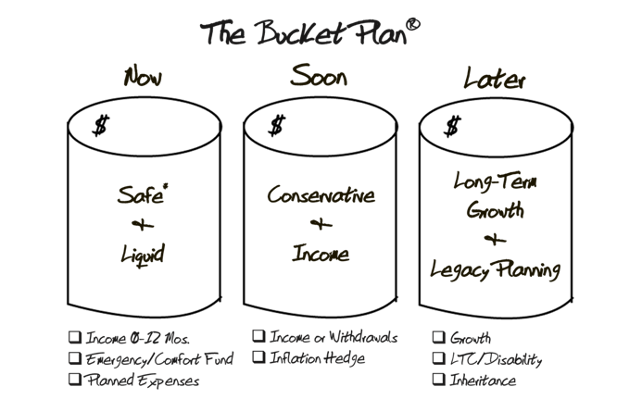
The Bucket Plan® is a holistic planning methodology that segments client assets into three time-based categories:
- Now Bucket (0-2 years): Emergency funds and planned near-term expenses, kept in the bank.
- Soon Bucket (2-10 years): Money needed sooner rather than later, invested conservatively. This protects clients from selling investments during market downturns while drawing income.
- Later Bucket (10+ years): Long-term growth assets and legacy planning. You can invest in this bucket more aggressively because the Now and Soon buckets provide a time horizon.
This simple visual is a powerful communication tool. Instead of explaining modern portfolio theory, you show clients three buckets. They can immediately grasp where their money goes and why.
[Related: The Bucket Plan® On-Demand: Communicating Financial Planning Concepts]
Real Results from The Bucket Plan®
Glen Pier, one advisor who implemented The Bucket Plan® in 2012, grew his firm’s AUM by $132 million.
And what about Scott’s results? After implementing the methodology in 2012, his firm saw 33% AUM growth and a 326% increase in annuity production over six years.
But for Scott, the real transformation was operational. The methodology became the intellectual property that differentiated his firm and allowed him to deliver comprehensive wealth management across financial planning, asset management, tax management, protection planning, and legacy planning.
[Related: 3 Key Strategies to Help Guide Clients Through Market Volatility]
How the 4-Step Process Makes It Systematic
Having a visual framework helps solve the client communication problem. But making that framework repeatable across your entire team requires a documented process.
The Bucket Plan® methodology includes a 4-step process: Discover, Design, Deliver, Dedicated. This process walks you through creating each client’s customized Bucket Plan:
1. Discover:
Build rapport and understand client priorities. The most successful advisors use what’s an upfront agreement in this first meeting to determine fit quickly:
- State the purpose of the meeting (what you’re trying to accomplish)
- Get their agenda (what they want to accomplish)
- Define your agenda
- Confirm the amount of time available
- Set the expected outcome
This helps you determine within the first 15-20 minutes whether the relationship is a good fit. If your agendas are too far apart, you’ll know right away.
The other critical element in Discover is positioning yourself as the professional who’s solved this problem before. Think about it like this.
You go to a heart doctor and they say, “I’ve never seen anything like this before, but maybe we can help you.” You will probably find another doctor. But if they said, “We’ve handled this for hundreds of patients. We have the expertise to help you,” you likely feel more confident moving forward.
2. Design:
Gather documents, assess cash flow, and sketch out their preliminary Bucket Plan. Your team handles the heavy lifting behind the scenes.
Here’s the key: give clients a preview of their three-bucket allocation before the final presentation. Don’t wait until the Deliver stage to show them anything. Get buy-in early by sketching where their money will go and why.
3. Deliver:
Present their complete Bucket Plan with a critical visual: their assets before and after the proposed transfers. Clients generally don’t understand how money moves or tax implications, so they are likely to appreciate a simple visual explaining “This is where your money is today” and “This is where it will be positioned over a period of time.”
You can explain that IRA-to-IRA transfers, for example, happen tax-free, eliminating a common unvoiced objection.
Walk through how each bucket serves their needs, proactively getting ahead of possible questions, then close them on becoming a wealth management client.
4. Dedicated:
Deliver streamlined onboarding, consistent annual reviews using The Bucket Plan® framework and ongoing education to identify new opportunities, and systematic referral generation.
The process gives you the roadmap. The Bucket Plan® gives you the framework. Together, they create a system any qualified team member can execute.
[Related: Financial Planning Simplified: Designing Your Client’s Bucket Plan]
Why This Creates Delegation and Scalability
Remember Scott’s challenge? He couldn’t train his son because planning lived in his head. That changed with The Bucket Plan®.
Scott’s son now handles all the technical planning work while Scott focuses on client conversations.
”It’s almost like I’m starting over again with all this new knowledge and these processes. I’m working more because I’m just doing the things I like.”
[Related: Structuring Your Financial Advisory Firm for Success]
How a Documented Planning Process Increases Advisory Firm Valuation
Scalability and delegation solve immediate operational problems. But they also create something more valuable: a business asset buyers may pay premium multiples for.
When buyers evaluate practices, they’re assessing one primary risk: founder dependency. If your business model relies on you being in every meeting, making every decision, and creating every plan, buyers see a liability. They’re purchasing a job that depends on you showing up every day.
A documented planning process changes that equation. Firms with transferable, repeatable processes are able to command higher valuation multiples because they’ve reduced key person risk.
When multiple team members deliver identical client experiences using a uniform visual framework and systematic process, you stand out. You offer something far more valuable than a client list. You’re selling a scalable business, not just a practice.
Start Building Your Scalable Financial Advisory Practice
The Bucket Plan® helps you delegate, train your team, and build a scalable practice that grows beyond your capacity.
Schedule a complimentary strategy call to discover how.
Plus, see if you qualify to attend The Bucket Plan® 1.0 training at no cost.
[Related: How Financial Advisors Can Attract and Retain High-Net-Worth Clients in 8 Steps]
FAQs: Building a Scalable Practice
You may have questions about building a scalable practice with The Bucket Plan®. Our FAQ has answers.
What increases the value of a financial advisory firm?
Consistent revenue streams, operational leverage, low founder dependency, documented processes, and the ability to scale without proportional cost increases. Firms with standardized planning systems like The Bucket Plan® typically command higher valuations than those dependent on individual advisor methodologies.
How do systems and processes impact financial advisor firm valuation?
Documented systems reduce buyer risk by demonstrating your firm’s value isn’t dependent on specific individuals. When processes are transferable and repeatable, buyers are more inclined to pay premium multiples because it increases confidence in business continuity and reduces integration risk.
What makes an advisory firm scalable?
The ability to serve more clients without proportionally increasing costs.
Standard processes like The Bucket Plan® methodology, effective delegation systems, and documented frameworks help you deliver consistent client experiences.
How does a unified planning process help reduce business risk?
By minimizing founder dependency and creating transferable intellectual property. When multiple team members can execute your planning approach (like Scott’s son executing The Bucket Plan®), key person departures won’t disrupt client relationships or operations.
Podcasts: Hear From Advisors Building Scalable Practices
Hear how other advisors are implementing scalable planning processes in their practices with our financial advisor podcasts. Stay sharp with real-world strategies and implementation insights from top-performing advisors:
For Financial Professional Use Only. This information is for educational purposes and not intended as individual investment, tax, or legal advice. Tax laws frequently change—consult with qualified professionals for current guidance.